
Long before Rwanda appeared on colonial maps, long before missionaries built their first churches in the hill country, and long before the modern nation-state drew its borders across Central Africa’s Great Lakes region, there existed a body of knowledge passed quietly between women. It moved mouth to ear, mother to daughter, aunt to niece.
It asked nothing of institutions and required no written record. It was simply known — the way farming seasons are known, the way grief is known. The practice called gukuna, the deliberate stretching of the labia minora, was one thread in that vast, unwritten inheritance.
Understanding where gukuna comes from — truly comes from, not the sanitized version filtered through decades of colonial documentation — requires patience with ambiguity and a willingness to sit with a culture on its own terms. It requires, as any honest anthropologist will admit, the humility to acknowledge that the written record only begins where outsiders started paying attention. What happened before that is known primarily through oral tradition, archaeological inference, and the living testimony of women who still carry the knowledge.
This is an attempt to piece together that older picture.
Rwanda Before the Record
The Kingdom of Rwanda, at its height, was one of the most centrally organized states in sub-Saharan Africa. By the time European explorers made contact in the late nineteenth century, Rwandan society had already developed a highly structured monarchy, a distinct cattle-based aristocratic culture, a complex legal code, and sophisticated oral literary traditions including praise poetry, dynastic recitations, and historical narrative passed across generations with remarkable precision. Historians working with these oral records — known as ibisigo — have reconstructed royal genealogies stretching back more than a dozen generations.
Within that society, gender roles were clearly defined but not without nuance. Women of the Tutsi aristocratic class occupied positions of social influence that surprised many early European observers. Women managed households of considerable economic complexity, participated in the social negotiation of marriages, and held recognized authority within female-specific domains — domains that male outsiders were rarely invited to observe.
It is within this female-specific domain that gukuna lived.
🌍 Cultural Insight
Pre-colonial Rwanda was governed by a mwami (king) whose authority was considered semi-divine. Society was organized into three groups — Hutu, Tutsi, and Twa — with distinctions based largely on economic role rather than the rigid racial categories later imposed during colonialism.
Anthropologists note that within Tutsi aristocratic culture, female beauty, deportment, and physical cultivation were subjects of serious social attention — and gukuna was part of that world.
Origins & Culture · Pre-Colonial Rwanda
What the Word Itself Tells Us
Language is often the most durable artifact a culture produces. The word gukuna comes from Kinyarwanda — the Bantu language of Rwanda — and means, roughly, “to pull” or “to stretch.” The related term gukuna imishino refers specifically to the elongation of the labia minora. Linguists studying Bantu language families have noted that terms for this practice exist across a wide geographic corridor that includes present-day Rwanda, Burundi, Uganda, and parts of the Democratic Republic of Congo, suggesting that the practice is considerably older than any single nation-state and likely predates the formation of the Rwandan kingdom itself.
Research by ethnolinguists studying the Great Lakes region suggests that body modification practices referenced in early Bantu vocabulary clusters date back at least a thousand years, and possibly further. This does not mean gukuna in its current form is that old in every detail, but it does suggest the concept of deliberate female body cultivation has deep roots in this linguistic and cultural family.
Who Practiced It — and Who Taught It
Historical accounts, gathered largely from Rwandan informants interviewed in the early-to-mid twentieth century by Belgian colonial ethnographers (notably Father Leon Classe and later academics), consistently describe gukuna as something transmitted within female networks. It was not a practice overseen by men, nor was it typically discussed in mixed-gender settings.
The teaching figure was most commonly described as a grandmother, aunt, or older female relative. Research into similar practices across the Great Lakes region suggests that the transmission was bound up with broader coming-of-age instruction — girls were taught about marriage, sexual conduct, household management, and body care as a unified curriculum of female knowledge. Gukuna was not isolated from that context; it was part of it.
Many women who have spoken with researchers about learning gukuna describe the instruction as matter-of-fact, unhurried, and embedded in an atmosphere of intergenerational female trust. There was no shame attached to the practice in its original context — shame, by most accounts, attached to not practicing it, as elongated labia were considered a mark of readiness, beauty, and self-discipline.
“Elongated labia were not a curiosity or a deviation — they were a recognized marker of womanhood, self-care, and cultural belonging. A girl who had done the work of gukuna announced, through her body, that she had been prepared.
— James Whitmore, Cultural Historian
The Social Function of Elongated Labia
To understand gukuna, one has to resist the temptation to see it through a purely aesthetic lens. Aesthetics were involved, certainly — Rwandan oral literature and praise poetry preserved references to the physical beauty ideals of women, and elongated labia were part of that vocabulary of desirability. But the social meaning went further.
Research suggests that elongated labia were understood to heighten sexual pleasure for both women and their partners, and this was spoken about openly within the context of marriage preparation. The practice was not secret in the sense of being shameful — it was private in the sense of belonging to a female sphere that men did not enter. Within that sphere, it was discussed with a frankness that surprised European observers who documented it.
There was also a dimension of identity and belonging. A woman who had practiced gukuna was signaling participation in a shared female tradition — she had received the knowledge, she had done the work, she belonged to the community of women who had done the same. In a society without written records of personal history, the body itself carried information about who a person was and where they came from.
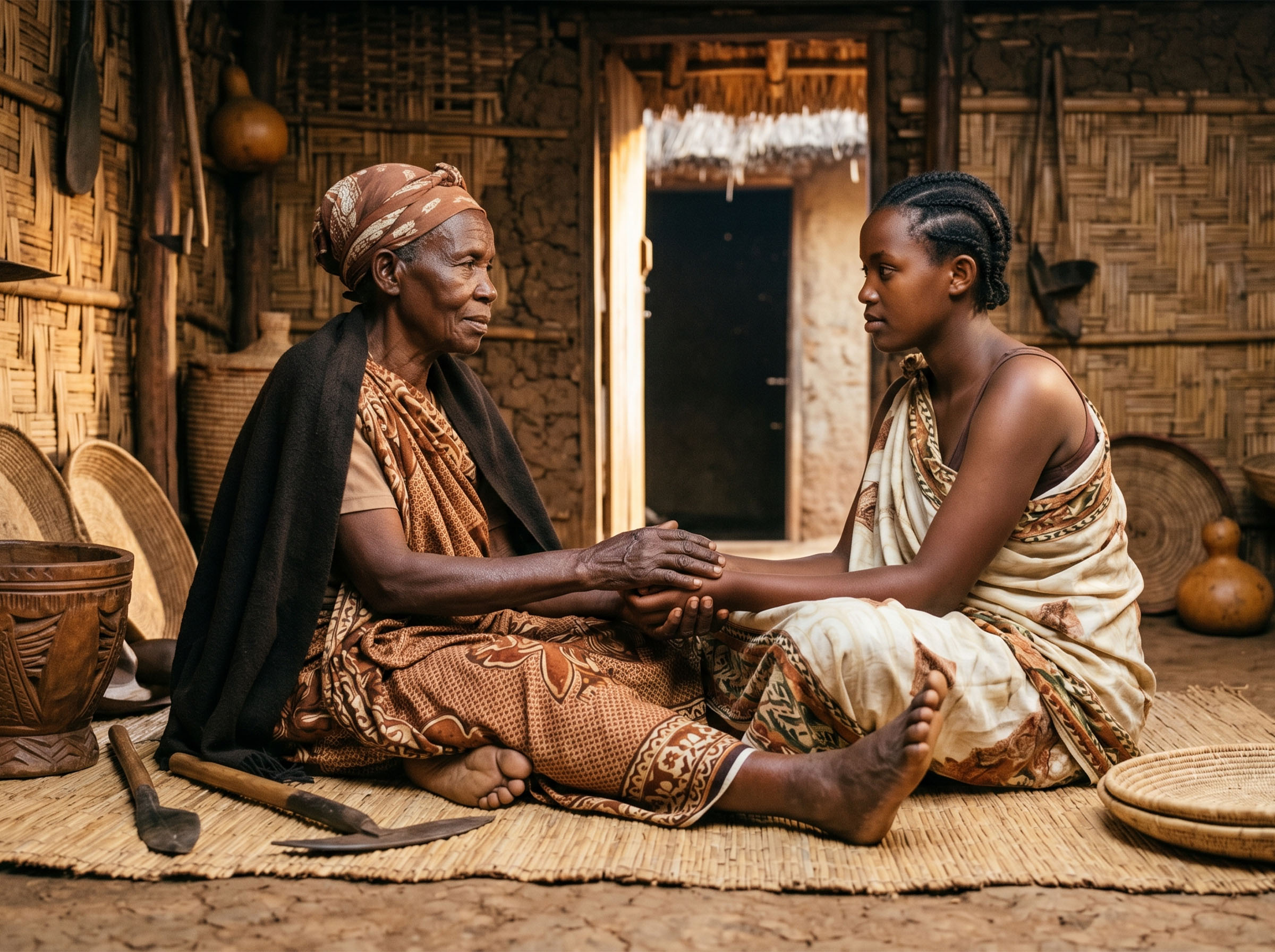
The transmission of gukuna was intergenerational — a grandmother or aunt guiding a younger woman through a body-knowledge tradition that required patience, privacy, and trust within the female community.
Intergenerational Knowledge · Origins & Culture
Gukuna Across the Great Lakes Region
One of the clearest signs that gukuna predates modern political boundaries is its geographic distribution. Ethnographic studies conducted across the twentieth century documented similar practices — under different names but with recognizable shared features — in Burundi (where it is often associated with Kirundi-speaking communities), in parts of Uganda among Baganda women, and among certain communities in what is now eastern Democratic Republic of Congo.
The consistency of certain elements across these cultures is striking: the use of plant-based preparations to soften the tissue; the involvement of an older female teacher; the association with marriage preparation; the expectation of elongation as a female norm rather than an exception. These cross-border consistencies suggest a shared cultural ancestor, a body practice that spread or evolved in parallel across the Bantu-speaking Great Lakes corridor over centuries.
📊 Regional Overview
The African Great Lakes region — Rwanda, Burundi, Uganda, and eastern DRC — where labia elongation traditions share deep Bantu cultural and linguistic roots.
Origins & Culture · Geographic Context
The Colonial Interruption
The arrival of German colonizers in the 1880s, followed by Belgian administration after World War I, brought with it a systematic effort to reshape Rwandan social customs through a combination of Christian missionary activity and administrative policy. Practices that fell outside European moral frameworks — particularly those involving female sexuality and the body — were categorized as primitive, unhygienic, or immoral and actively discouraged.
The historical record shows that gukuna was among the practices targeted. Mission schools, which became the primary access point for education and economic advancement under colonial rule, taught girls that such customs were incompatible with Christian womanhood. The result was not the elimination of gukuna but its further retreat into privacy. A practice that had been confidential but unstigmatized within Rwandan culture became, in the colonial period, something women actively hid from institutions while preserving among themselves.
This is a pattern seen across many indigenous body traditions in colonial Africa: the practice survived not because colonialism failed to notice it, but because it moved deeper into female-controlled spaces that institutions could not easily reach.
💡 Did You Know?
Belgian colonial ethnographers who documented Rwandan customs in the early twentieth century recorded gukuna but often did so with language shaped by their own cultural biases — describing it as aberrant or troubling. Modern anthropologists revisiting those same records have found that the informants themselves described the practice with pride and matter-of-fact normalcy. The bias, historians now note, was in the recorder, not the recorded.
Gukuna as a Rite of Passage
Anthropologists who have worked directly with Rwandan communities note that gukuna was not a single event but a sustained practice — something a girl began, typically between the ages of eight and twelve in many historical accounts, and continued over months or years until the desired result was achieved. This time investment meant it was woven into daily life, not set apart as a single ceremony.
Yet it was connected to ceremony. The broader rite of female initiation in pre-colonial Rwanda involved multiple elements: instruction in household management, sexual education, physical preparation of the body, and the social presentation of a girl as a woman ready for marriage. Gukuna was one component of that broader preparation, and its completion was understood as part of being ready — physically, socially, and culturally — to enter adult female life.
Research among older women in Rwanda conducted in the late twentieth century found that many still remembered gukuna as something their grandmothers had taught them, though by that point the practice had become less universal than it once was. Women who had learned it in the traditional way described it with warmth and without embarrassment — as a connection to their grandmothers, to their girlhood, and to a specifically Rwandan way of being a woman.
The Plant Knowledge That Accompanied the Practice
Oral tradition and ethnographic records both indicate that gukuna was not performed without preparation. Women used plant-based preparations — typically oils or plant juices derived from locally available flora — to soften the labial tissue before manipulation. The specific plants mentioned vary by region and informant, but the principle was consistent: the tissue was prepared, the process was gradual, and care was taken.
This plant knowledge was itself a form of transmitted female expertise. Knowing which plants to use, how to prepare them, and how to apply them safely was part of what an older woman passed to a younger one. It embedded gukuna within a broader tradition of female botanical knowledge — the kind of knowledge that governed healing, nutrition, and body care across many traditional African societies.
It also complicates any simple reading of gukuna as mere cosmetic modification. The practice came embedded in a knowledge system, a relational context, and a set of values about the female body that were coherent, purposeful, and internally meaningful.
🌿 Anthropological Note
The Plant Knowledge Layer: Across the Great Lakes region, women practicing labia elongation historically used botanicals including Senna leaves, certain tree barks, and plant-derived oils. This botanical knowledge was specific, regionally varied, and transmitted only within female networks — making it nearly invisible to colonial-era male ethnographers who documented the practice.
Modern ethnobotanists working with elderly women in Rwanda and Burundi have worked to document this plant knowledge before it is lost — recognizing it as a distinct body of indigenous expertise in its own right.
What Survived — and What Changed
Gukuna did not disappear. Studies conducted in the early 2000s, as well as reporting by organizations working in Rwanda on women’s health and cultural heritage, consistently found that the practice remained alive — though its context had shifted. In contemporary Rwanda, gukuna is practiced by some women as a deliberate reclamation of cultural heritage, by others as a personal choice independent of traditional framing, and by still others in continuation of what their mothers and grandmothers taught them.
What has changed is the social scaffolding around it. The rite of passage context has weakened. The botanical knowledge has become less widely shared. The intergenerational female networks that once transmitted gukuna as a coherent curriculum have thinned under the pressure of urbanization, missionary-influenced social norms, and the general disruption caused by the 1994 genocide, which devastated communities and severed countless threads of oral transmission.
What has not changed is that women still know about it, still practice it, and — increasingly, as Rwandan cultural pride has grown in the decades since the genocide — discuss it as part of a specifically Rwandan heritage worth understanding and, for some, preserving.
Rwanda is one entry point into a much wider field of female body traditions across the continent. Labia elongation traditions across Africa span dozens of ethnic groups and reveal a consistent thread: the deliberate cultivation of the female body as a site of cultural meaning, personal identity, and social belonging. Gukuna is not an anomaly. It is part of a continental conversation that has been going on for a very long time.
Reading the Practice on Its Own Terms
The anthropological challenge of gukuna — and of body modification traditions generally — is resisting the urge to interpret them through frameworks imported from outside. Both the missionary impulse to condemn and the modern liberal impulse to celebrate can distort understanding if they override careful attention to what the practice actually meant within its own context.
What the evidence suggests, read as carefully and honestly as the record allows, is this: gukuna in pre-colonial Rwanda was a coherent cultural practice embedded in a sophisticated social world. It was transmitted through female networks with care and intention. It was understood to serve multiple purposes — aesthetic, social, relational, and erotic — without those purposes being seen as contradictory. It was part of how a society organized the transition from girlhood to womanhood and how women signaled participation in a shared cultural identity.
That it was practiced in ways that look nothing like anything on a modern Western aesthetic menu is not evidence of backwardness. It is evidence of a different civilization with a different set of answers to the perennial human questions about the body, beauty, and what it means to grow up.
For readers wanting a broader historical foundation, the history of labia stretching in East Africa traces how these practices evolved across pre-colonial, colonial, and post-colonial periods — and what that long arc reveals about cultural resilience.
Gukuna survived everything that was thrown at it. That, too, is part of what it is.
📌 By The Numbers
Frequently Asked Questions: The Roots of Gukuna
📖 In Brief
- Gukuna (Kinyarwanda: “to pull/stretch”) refers to deliberate labia minora elongation practiced in pre-colonial Rwanda and beyond.
- The practice predates the Rwandan kingdom and is rooted in a wider Great Lakes Bantu cultural tradition estimated at over a thousand years old.
- Transmission was exclusively female — passed from grandmother or aunt to younger women as part of broader coming-of-age instruction.
- Plant-based preparations were used to soften tissue; botanical knowledge was an integral component of the tradition.
- Colonialism forced the practice into greater secrecy without eliminating it — it survived within female-controlled private spaces.
- Gukuna persists in contemporary Rwanda and is increasingly discussed as part of a cultural heritage worth preserving and understanding.


Leave a Reply