
In Brief
- Labia stretching — known by dozens of local names — is a body modification tradition practiced for centuries across sub-Saharan Africa and beyond.
- It carries distinct cultural, ritual, and personal meaning, varying significantly by region, ethnic group, and generation.
- Western audiences have frequently misread the practice through the lens of their own cultural assumptions.
- Online censorship of the topic has created a knowledge gap that educational resources are working to fill.
- Global curiosity about the practice has grown, driven by documentary culture, anthropological publishing, and wellness communities.
There are traditions that survive not because they are simple, but because they carry weight — weight measured not in grams, but in meaning. Labia stretching is one such tradition. Practiced quietly across generations in parts of Africa, passed from elder to younger woman in private rooms and riverside retreats, it persists today alongside smartphones and social media algorithms that would sooner erase it than explain it.
This is an attempt to explain it. Honestly. Without flinching, without moralizing, and without the particular brand of cultural arrogance that assumes an old practice must justify itself to modern sensibilities before it earns the right to be understood.
What follows is a documentary archive of one of the world’s most misunderstood body traditions — its origins, its meanings, its regional expressions, and the curious global audience it has attracted in the twenty-first century.
“ It persists today alongside smartphones and social media algorithms that would sooner erase it than explain it. This is an attempt to explain it — honestly, without flinching. — James Whitmore, Cultural Historian
The Historical Origins of Labia Stretching
Historians and anthropologists have traced documentation of labia elongation across sub-Saharan Africa to at least the sixteenth century, though oral traditions suggest the practice is far older. Early European explorers — most of them poorly equipped to understand what they were observing — left written accounts of what they called the “Hottentot apron” among the Khoikhoi and San peoples of southern Africa. These accounts ranged from clinical curiosity to outright horror, rarely pausing to ask what the practice meant to the women who carried it.
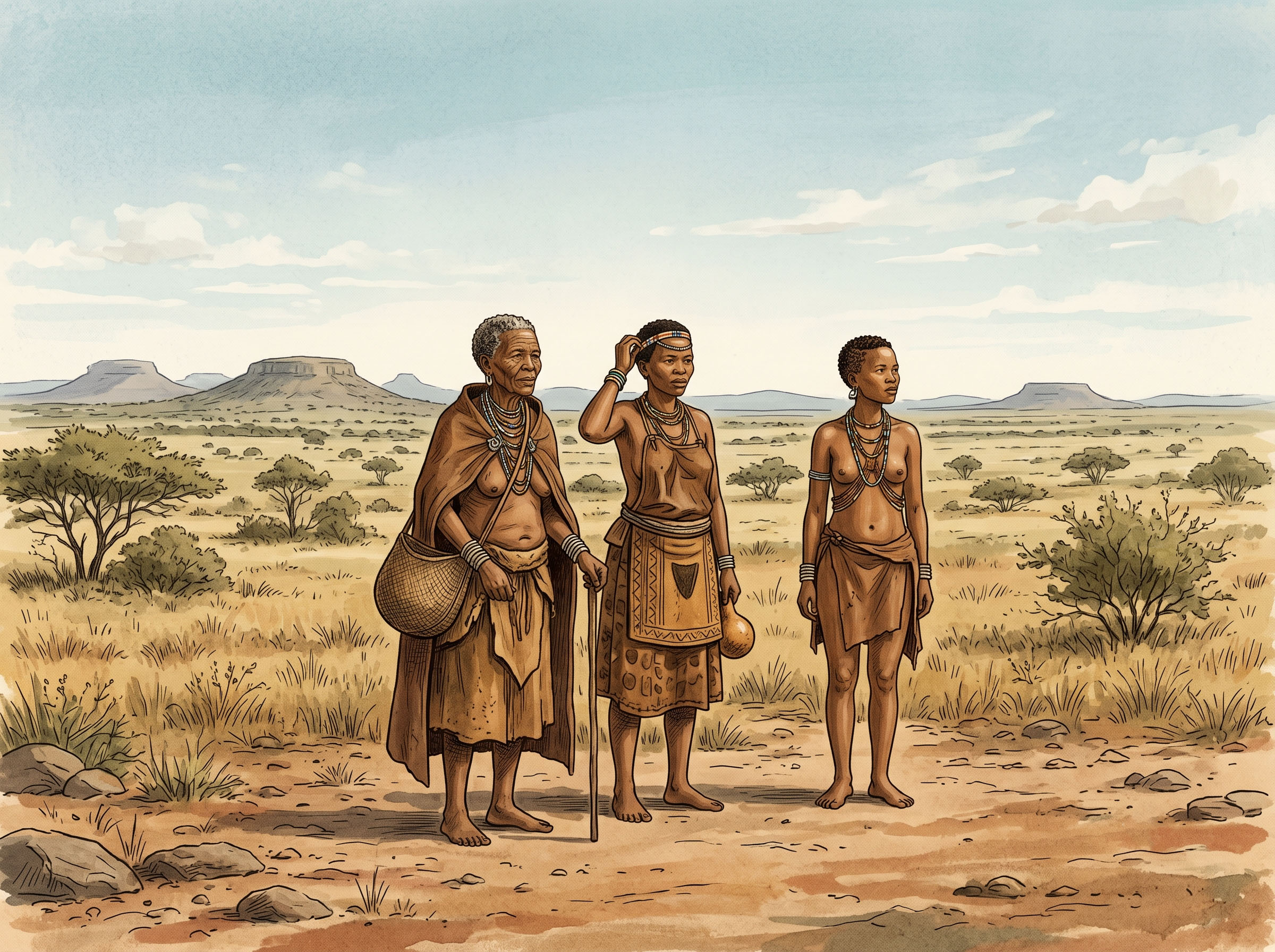
The Khoikhoi and San, sometimes collectively referred to as Khoisan, are among the oldest continuous human populations on earth. Genetic and archaeological evidence places their ancestors in southern Africa for tens of thousands of years. Within these communities, labia elongation was — and in some families remains — a mark of feminine identity and preparation for adult life. Researchers studying oral histories have recorded accounts of the practice being taught by grandmothers to granddaughters, framed not as an obligation but as a form of bodily knowledge passed down like a recipe or a song.
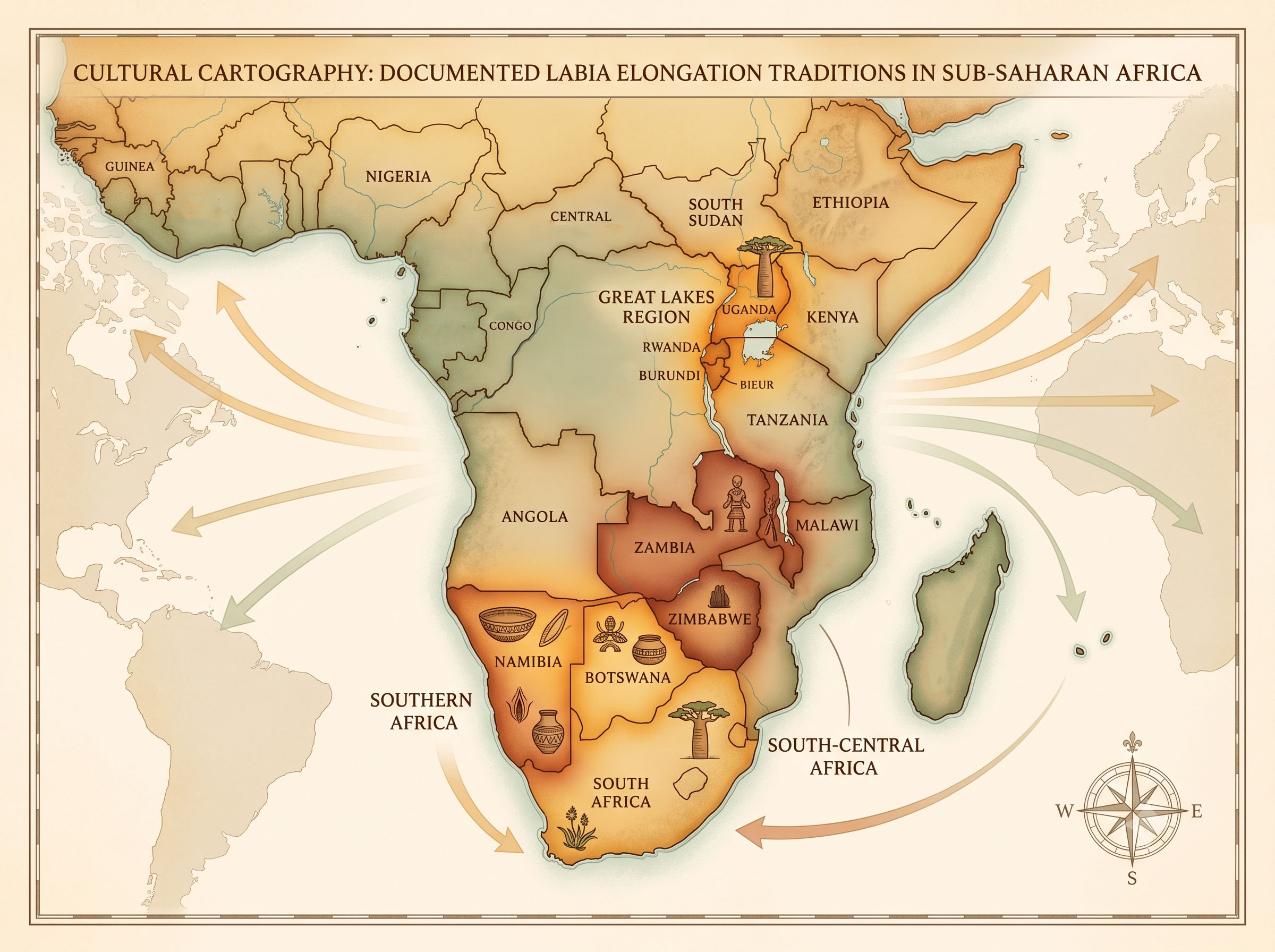
Beyond the Khoisan, documentary evidence places the tradition across a broad arc of African cultures: among Rwandan and Burundian Tutsi communities, where it is called gukuna; among the Balobedu and Venda of the Limpopo region in South Africa; among Ugandan Baganda women; and across parts of Zambia, Zimbabwe, Malawi, and Mozambique. Each group arrived at the tradition independently — or diffused it across migration routes now impossible to reconstruct with certainty — but the practice converged on similar forms.
Historical field notes from late nineteenth-century missionaries contain some of the earliest systematic descriptions, though these sources must be read critically. Missionaries were typically hostile to indigenous body practices and filtered their observations through theological disapproval. More reliable ethnographic accounts emerged in the mid-twentieth century, when anthropologists began recording testimony directly from women practitioners.
Cultural Insight
The Gukuna Tradition of Rwanda & Burundi
Among Rwandan and Burundian communities, labia elongation is called gukuna — from the Kinyarwanda verb meaning “to pull.” Historically, it was taught by aunts and elder women to girls in the years before marriage.
Research conducted by Rwandan and international scholars has found that many women associate the practice with cultural pride, adult readiness, and a sense of continuity with their mothers and grandmothers.
Studies have noted that in urbanizing communities, the practice is changing — sometimes abandoned, sometimes quietly maintained alongside modern life.
What the Practice Actually Involves
Labia stretching — also called labia elongation or labia pulling — involves the gradual, manual extension of the labia minora (the inner lips of the vulva) over an extended period of time. The process is typically initiated during adolescence and continued over months or years, using repetitive manual techniques. In some traditions, plant-based preparations were applied to the skin; in others, the practice was entirely manual. Methods vary significantly by region and community.
The result is an extension of tissue that, across cultures where the practice exists, is considered aesthetically desirable and culturally significant. In a number of communities, elongated labia are associated with sexual maturity, feminine elegance, and marital readiness. In others, the association is more broadly with womanhood itself — with belonging to a lineage of women who have marked their bodies in the same way.
It is worth being precise about terminology: this is not female genital mutilation (FGM) as defined by the World Health Organization or as condemned under international human rights frameworks. FGM involves cutting, removing, or injuring external genital tissue. Labia stretching, by contrast, involves elongation through applied tension over time — a mechanical process comparable in some ways to the earlobe stretching practiced in dozens of cultures worldwide, including among the Maasai of Kenya and Tanzania, or the lip plates worn by Mursi women in Ethiopia.
Regional Variations Across the African Continent
One of the most important things researchers have documented is the absence of a single uniform tradition. Labia stretching, across the regions where it is practiced, looks different, means different things, and is carried by different social actors depending entirely on where you are standing.
Regional Variations at a Glance
| Region / People | Local Name | Who Teaches It | Primary Association |
|---|---|---|---|
| Khoisan (Southern Africa) | Tablier (historical Western term) | Grandmothers, elder women | Cultural identity, ancestral continuity |
| Rwanda / Burundi (Tutsi & others) | Gukuna | Aunts, senior female relatives | Marital readiness, feminine maturity |
| Uganda (Baganda) | Okuzina | Ssenga (paternal aunt) | Preparation for marriage, sexual education |
| Zimbabwe / Zambia / Malawi | Various (regional dialects) | Female initiation guides | Rite of passage, womanhood |
| South Africa (Venda, Balobedu) | Regional terms | Initiation elders | Cultural belonging, adult identity |
| Global (modern, non-traditional) | No fixed term | Self-directed / online communities | Body autonomy, personal aesthetics, curiosity |
Among the Baganda of Uganda, the tradition is taught by the ssenga — the paternal aunt, who historically served as the primary sex educator for young women in the family. The ssenga relationship is a formal cultural institution; she is a confidante and teacher on matters ranging from marital conduct to body care. Labia elongation sits within this broader curriculum of female preparation. Research by Ugandan scholars has noted that the ssenga role has adapted in urbanized settings, with some practitioners now working professionally in cities, preserving a version of the tradition outside its original village context.
In Malawi, Zambia, and Zimbabwe, researchers have documented the practice as part of structured female initiation rites. These are not casual events but formalized ceremonies — sometimes lasting days — in which girls transition to womanhood under the guidance of experienced women. Body knowledge, including labia stretching, forms one component of a broader curriculum that covers adult relationships, household responsibilities, and community expectations.
Symbolism and Meaning — What Elongated Labia Represent
To understand why the practice persists, it is necessary to understand what it means — and meaning, in this context, is not singular. Across regions and generations, labia elongation has carried overlapping but distinct associations.
Sexual and marital significance. In many communities, elongated labia are considered sexually attractive and are associated with heightened pleasure for both women and their partners. Many women in communities where the tradition is practiced report that elongated labia are considered a sign of a skilled and prepared woman. This is not a minor cultural footnote — in communities where the practice is embedded, the absence of elongation can carry social stigma, while its presence signals readiness and desirability.
Rite of passage and belonging. In initiation-centered traditions, the act of stretching is inseparable from the transition to adulthood. It is something a girl does as she becomes a woman — not necessarily because she chooses it from a menu of options, but because it is the expected expression of that transition within her community. The practice marks membership: I belong to this lineage of women.
Ancestral continuity. In communities with strong ancestor reverence, body traditions carry a dimension beyond the personal. Doing what your mother and grandmother did is a form of fidelity to the dead — a way of keeping a lineage’s identity alive in the body of a living woman. This is a layer of meaning that purely individualist frameworks struggle to accommodate.
Pleasure and personal knowledge. Many women who practice labia stretching — both within traditional communities and in modern, non-traditional contexts — report that it increases their awareness of and comfort with their own bodies. Historical field accounts from female anthropologists working in East Africa noted that women spoke about the practice with a matter-of-factness that suggested intimate bodily knowledge rather than compliance with external demands.
Did You Know?
The term “Hottentot apron” — used by European colonists to describe elongated labia among Khoisan women — was a derogatory label that became infamous after Sarah Baartman (also called “Saartjie”) was displayed in European exhibition halls in the early 1800s. Her body was treated as a racial curiosity. After decades of advocacy, her remains were repatriated to South Africa in 2002 — a landmark moment in the reclamation of African bodily dignity. Her story is inseparable from any honest account of how labia elongation has been documented and discussed in the Western world.
The Western Gaze — Cultural vs. Colonial Interpretations
No examination of labia stretching is complete without accounting for how Western observers have historically interpreted — and misinterpreted — the practice. From the earliest colonial-era accounts to contemporary internet debates, the tradition has been consistently read through frameworks that prioritize Western anatomical norms as the default.
The most consequential misreading has been the conflation of labia elongation with harm. When European doctors examined Khoisan women in the 1800s, many could not separate their aesthetic unfamiliarity with the appearance of elongated labia from a medical judgment that something had gone wrong. The body that did not match their anatomical atlas was treated as aberrant. This was not science — it was cultural projection dressed in clinical language.
A more nuanced but still distorting lens is the contemporary tendency to read all non-Western body traditions through a human rights framework developed in specifically Western liberal contexts. This framework has done important work in challenging genuinely harmful practices — including forms of FGM that cause lasting injury. But applied indiscriminately, it flattens the differences between traditions that cause harm and traditions that do not, between practices imposed through violence and practices transmitted through teaching. Researchers working directly with communities have noted that conflating these categories causes real damage: it shuts down conversation, misrepresents women who practice voluntarily, and removes their agency from the story.
The distinction matters. A woman in Kigali who learned gukuna from her aunt as a teenager and continues the practice as an adult married woman is having a fundamentally different experience from a woman subjected to forced cutting. Treating these as morally equivalent is not a protection — it is a new form of the same old failure to listen to African women’s own accounts of their bodies.
Cultural Distinction
Labia elongation is not classified as Female Genital Mutilation (FGM) by the World Health Organization. FGM involves partial or total removal or injury of external female genital organs. Labia stretching involves gradual extension of tissue through applied tension — no cutting, no removal, no structural damage. The two are anatomically and ethically distinct practices that have been erroneously grouped together in some Western policy discussions.
Modern Perspectives — A Tradition in Motion
Traditions do not stand still. They move with the people who carry them — into cities, across borders, and into new contexts that the originators of the practice could not have imagined.
In urban Rwanda, Uganda, and South Africa, researchers have found that labia elongation continues, but in modified forms. Some women learn from the internet rather than from aunts. Some practice alone rather than in group initiation settings. Some have retained the practice while discarding other elements of the initiation tradition it once belonged to. This is not corruption of the tradition — it is what traditions do when they survive. They adapt.
At the same time, a parallel phenomenon has emerged in the West: women with no African heritage discovering labia stretching through documentary films, anthropological publications, and online communities, and choosing to adopt the practice for their own reasons. These reasons range from aesthetic curiosity to body positivity to a straightforward interest in exploring their anatomy. Many women report a sense of increased body awareness and comfort. This global diffusion is a new chapter in the tradition’s history — one that raises genuine questions about cultural context while also demonstrating the practice’s capacity to carry meaning in settings its originators never anticipated.
Research exploring modern adoption of the practice outside traditional communities suggests that women approach it primarily as a personal choice — something done in private, often over a long period, and rarely discussed openly because of the social stigma attached to female genital subjects in Western cultures.
Why the Topic Became Taboo Online
For anyone who has tried to research labia stretching using conventional search engines or social platforms, the experience is familiar: results are sparse, accounts are removed, and communities dedicated to the topic operate in the margins. This is not accidental.
The major social media platforms — Facebook, Instagram, TikTok, YouTube — operate content moderation systems built primarily around one consideration: the appearance of genitals. These systems are almost entirely automated and cannot distinguish between pornographic content and an ethnographic documentary. A discussion of Khoisan body traditions with anatomically accurate imagery triggers the same filter as explicitly sexual content. The result is systematic erasure of legitimate cultural and educational material about female anatomy.
This has created a knowledge desert. The gap left by platform censorship is filled partly by prurient content that has no educational value, and partly by nothing at all — meaning that curious readers who want accurate historical and cultural information have very few places to go. Publications like this one exist specifically because that gap is real and its consequences are not trivial. Women who grew up in communities where labia stretching is practiced often find they cannot easily discuss or research their own traditions online. Women in Western countries who have discovered the practice through documentary viewing cannot find neutral, educational resources. Both groups deserve better.
The broader pattern is worth naming: when platforms decide that any content touching on female genitalia is by definition suspect, they apply a standard that would eliminate entire shelves of anthropology, anatomy, and women’s health literature from the public record. That is a censorship problem, not a safety achievement.
By the Numbers
14+
African countries where labia elongation has been documented by researchers
1800s
Earliest systematic Western ethnographic accounts of the tradition
2002
Year Sarah Baartman’s remains were repatriated to South Africa after 187 years
3+
Distinct regional names for the practice in East Africa alone
Myths and Misconceptions — Setting the Record Straight
Given how little accessible information exists on the subject, myths have filled the void. Some originate in colonial-era writing, some in contemporary internet culture, and some simply in the human tendency to project familiar frameworks onto unfamiliar practices.
Myth: It is the same as female genital mutilation. As established above, this is anatomically and legally incorrect. The WHO’s own classification system distinguishes between FGM and non-harmful genital modification practices. The conflation is politically motivated in some cases and simply uninformed in others.
Myth: It is always done against a woman’s will. Research across multiple communities has found considerable variation in how the practice is transmitted and experienced. In some traditional contexts, there is social pressure — as there is with most rites of passage in any culture, including Western ones. In others, the practice is explicitly voluntary and undertaken with enthusiasm. Modern adoption entirely outside traditional communities is, by definition, self-directed.
Myth: It is primarily sexual in motivation. While sexual significance is part of the tradition in some communities, reducing the practice to its sexual dimension misses the majority of its cultural content: identity, belonging, passage, lineage, and body knowledge. Many women who practice report motivations that have nothing to do with sexuality at all.
Myth: It is a fringe or dying tradition. Studies conducted in Rwanda, Uganda, and Zimbabwe in the past decade have found ongoing practice among significant numbers of women, including urban women. The tradition is changing, but it is not disappearing.
Myth: Western women cannot understand or practice it without appropriating it. This is a more contemporary misconception, found in certain online debates. Cultural practices have always moved across populations — the history of human civilization is largely a history of cultural borrowing, adaptation, and exchange. The more important question is whether a practice is being appropriated dismissively or engaged with respectfully, and whether the source communities are being acknowledged and supported.
For a deeper examination of the historical roots explored here, the documented accounts of communities across sub-Saharan Africa, and the early anthropological record, read the full historical overview at The Ancient Tradition of Labia Stretching — a comprehensive archive of the practice’s earliest documented origins.
Why Global Curiosity Has Grown
It would be easy to attribute contemporary Western interest in labia stretching to little more than internet novelty — a curiosity that surfaces when algorithms serve unusual content. But that explanation is too shallow. Several distinct forces have driven genuine, sustained interest in the topic.
Documentary culture has played a significant role. The growth of streaming platforms and long-form documentary series has exposed Western audiences to African body traditions — including labia elongation — in contexts that present them as worthy of attention rather than horror. BBC documentaries, independent films, and academic lecture series available online have introduced the topic to audiences who encounter it through the lens of anthropology rather than sensationalism.
The body positivity movement — whatever its political complexities — has contributed to a broader cultural permission to discuss female genital anatomy without shame. Women who might previously have felt unable to research or discuss aspects of their own bodies have, in the past decade, found more space to do so. Some have discovered labia stretching through this route and approached it with genuine curiosity about whether it might be meaningful for them personally.
Academic publishing has also opened up. Peer-reviewed journals in anthropology, women’s studies, and African studies have produced significant research on labia elongation in the past twenty years. This material, increasingly accessible through open-access databases, has given curious readers something beyond speculation to engage with.
Finally, diaspora communities have brought the tradition into new countries. Women who grew up with labia stretching as part of their cultural formation and now live in Europe, North America, or Australia carry the practice with them — and in some cases, discuss it openly in ways that introduce it to their neighbors and communities.
If you are exploring the practice for the first time and want to understand what manual labia stretching involves in practice — including what to expect and how it is approached in both traditional and modern contexts — visit the guide to manual labia stretching on this site.
Conclusion — A Tradition That Demands Honest Attention
Labia stretching is not a simple subject, and it resists simple conclusions. It is a body tradition with roots that run centuries deep in several distinct African cultures. It carries layers of meaning — ritual, relational, ancestral, personal — that cannot be reduced to any single framework. It has been misrepresented by colonists, misclassified by some health organizations, erased by content algorithms, and simultaneously discovered by a global audience hungry for genuine cultural knowledge.
What it deserves — what the women who carry it have always deserved — is honest attention. Not the attention of spectacle, not the attention of judgment, but the attention of genuine curiosity: the kind that asks what something means before deciding what to think of it.
For the documentary explorer, the cultural historian, the woman who grew up with this tradition, and the woman who discovered it last month on a streaming platform, the practice offers something rare: a window into the extraordinary variety of ways that human beings have understood, marked, and honored the female body. That is worth understanding.
“ What it deserves — what the women who carry it have always deserved — is honest attention. Not the attention of spectacle, not the attention of judgment, but the attention of genuine curiosity: the kind that asks what something means before deciding what to think of it. — James Whitmore, Cultural Historian
Frequently Asked Questions
Labia Stretching — Questions & Answers


