
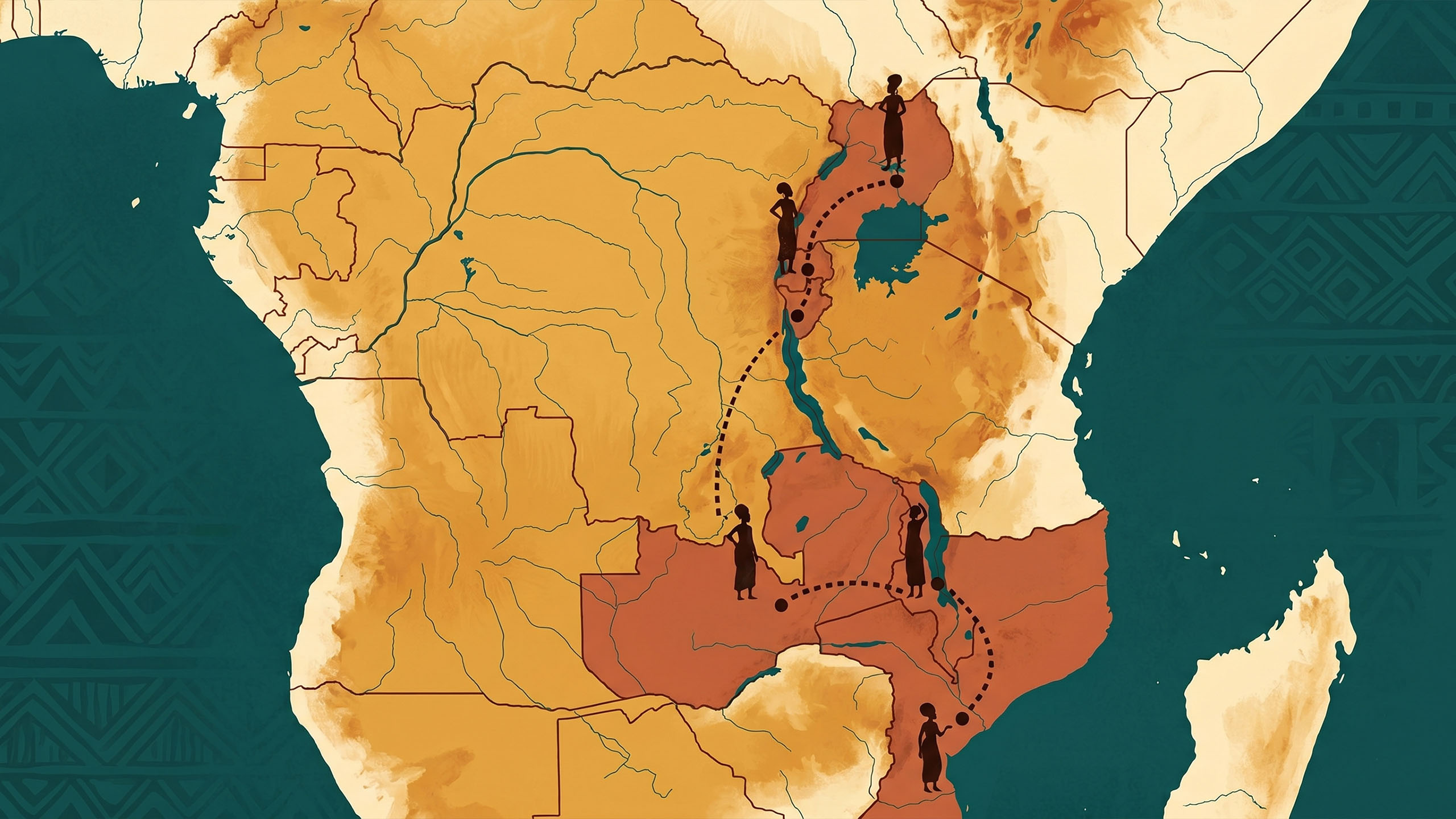
Somewhere between the forested hills of Burundi and the wide, grassy plains stretching toward Lake Malawi, a practice has been quietly observed, passed down, and debated for generations. It takes place in private — between mothers and daughters, between aunts and nieces, between older women who carry the knowledge and younger ones who are beginning to understand what it means. It involves the careful, deliberate lengthening of the labia minora, the inner folds of the female genitalia, and it is known by different names across the region. In Uganda it is called kachupuli or enjoja. In Rwanda and Burundi it is spoken of as gukuna imitwarho. In Zambia and parts of Malawi it is simply referred to as “pulling” — a body tradition so deeply embedded in certain communities that girls who did not practice it were sometimes considered culturally incomplete.
This is not a marginal or recent phenomenon. Ethnographic records from the early twentieth century document it across sub-Saharan Africa with consistent descriptive detail. Oral historians from Zimbabwe and Tanzania have traced its origins beyond living memory, connecting it to ancestral frameworks of womanhood, pleasure, and identity. Yet for much of the Western world, the tradition has remained invisible — partly due to the difficulty of discussing female anatomy in mainstream publishing, and partly because it simply did not fit a tidy narrative. It was not FGM. It was not surgical. It was not imposed in the way colonial observers expected bodily rituals to be imposed.
What follows is a cultural and historical field survey — a region-by-region account of how labia stretching has been understood, practiced, and transmitted across eastern and southern Africa, and what it continues to mean for women navigating both ancestral identity and the pressures of the modern world.
A Practice Older Than Borders
The nation-state borders that divide Uganda from Rwanda, Zambia from Mozambique, are colonial inventions — drawn in the late nineteenth century by European administrators with little knowledge of, or interest in, the cultural geographies already in place. The traditions that existed before those borders rarely respected them, and labia stretching is among the most compelling examples.
Archaeological and anthropological research suggests that body modification traditions across sub-Saharan Africa have existed for thousands of years, with many practices recorded in early Arabic and Portuguese traveler accounts from the fifteenth and sixteenth centuries. Specifically, written records from the Swahili coast and the Great Lakes region reference elongated labia as an observed characteristic of women in those areas, sometimes noted with colonial bewilderment and sometimes with ethnographic curiosity.
The practice appears to belong to a broader category of body transformation common to many pre-colonial African societies — alongside scarification, neck elongation, ear stretching, and tooth shaping — traditions that used the body as a canvas for cultural identity. Unlike purely ornamental modifications, however, labia stretching occupied a functional position within many communities. Historically, societies have understood elongated labia as a marker of feminine readiness, sexual sophistication, and the ability to give and receive pleasure. It was a preparation, not merely a decoration.
Research from the 1950s and 1960s by ethnographers including Jean La Fontaine (working among the Gisu of Uganda) and Audrey Richards (in central Africa) documented the practice in its traditional social contexts. More recent work by scholars such as Sara Jewitt and Helen Ryley at the University of Nottingham has revisited the topic through postcolonial frameworks, finding that the practice is both more geographically widespread and more culturally layered than earlier accounts acknowledged.
“The nation-state borders that divide Uganda from Rwanda, Zambia from Mozambique, are colonial inventions. The traditions that existed before those borders rarely respected them.”
— James Whitmore, Cultural Historian
What the Tradition Actually Means
To understand labia stretching as a cultural practice, one must first set aside the instinct to evaluate it through a Western lens. In the communities where it originates, the tradition does not exist in isolation. It belongs to a wider constellation of teachings — about the body, about womanhood, about the relationship between a woman and her partner, and about what it means to come of age within a specific cultural community.
For an introduction to how these meanings take shape across the continent, the origins, meaning, and cultural context of this practice offers a foundational overview that situates the tradition within its broader historical frame.
In most communities where labia stretching is practiced, it carries several overlapping meanings simultaneously. The first is preparatory — the practice is believed to increase the sensitivity of the labia and, in the understanding of many traditional communities, to enhance a woman’s capacity for pleasure. The second is social — elongated labia have historically been understood as a sign that a woman has taken care of herself, paid attention to her body, and participated in the knowledge systems of her community. The third is relational — in many of these cultures, a man’s pleasure is also considered to be connected to the physical characteristics of his partner’s anatomy, and elongated labia were historically viewed as desirable. The fourth meaning is initiatory — in some traditions, labia stretching forms part of a broader initiation sequence that marks the passage from girlhood to womanhood.
These meanings are not static. They have shifted over generations as communities have encountered Christianity, Islam, colonial administration, urban migration, and the internet. But at the core, what the practice represents is a form of bodily self-knowledge — a physical practice rooted in the idea that a woman’s body is worth attending to, worth understanding, and worth transforming.
The Language of the Tradition
The words used for labia stretching across different African languages reflect the specific cultural weight each community places on the practice:
- Enjoja (Uganda/Luganda) — pulling, extending
- Gukuna imitwarho (Rwanda/Kinyarwanda) — “pulling the inner lips”
- Ukufininga (Zambia/Bemba) — stretching, preparation
- Chinamwali (Malawi) — refers broadly to coming-of-age rites including the practice
- Kuzolola (Mozambique/Makonde) — elongation, growth
Language preserves what silence erases. Each term carries a lineage.
Uganda: The Great Lakes Heartland
Uganda is arguably the country where labia stretching has received the most sustained documentation and public discussion in recent decades, partly due to advocacy work by organizations studying female sexual health and partly because the practice is deeply embedded in the cultures of its largest ethnic groups, including the Buganda, Banyankole, Baganda, and Basoga.
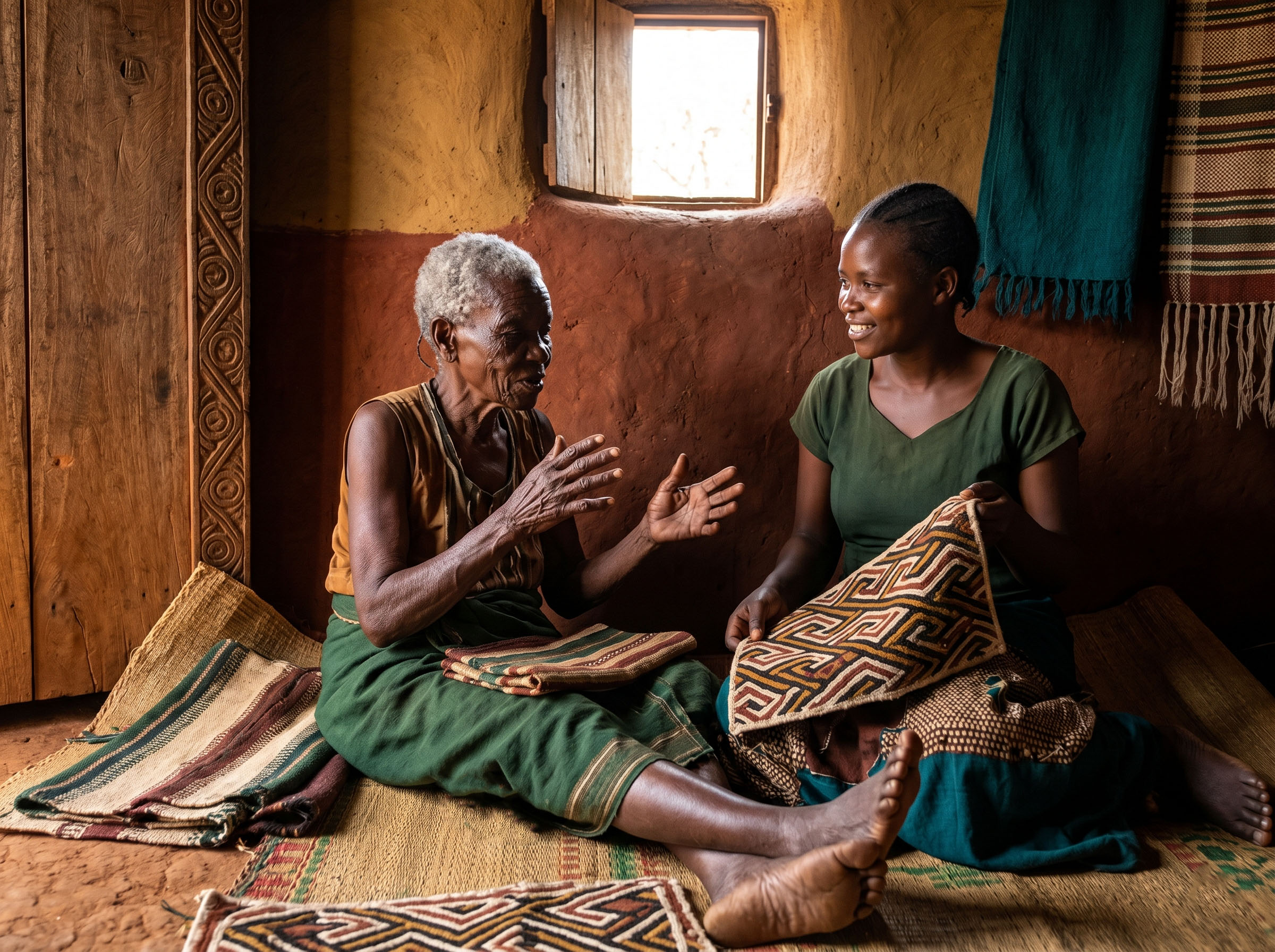
Among the Baganda — Uganda’s largest ethnic group, historically centered around Kampala and the northern shores of Lake Victoria — labia stretching has been documented as a practice typically beginning around the time of puberty. Older female relatives, most often aunts or grandmothers, would introduce young girls to the practice and guide them through it. The process was gradual, performed over weeks or months, and accompanied by instruction about female sexuality, marriage, and the responsibilities of adult womanhood.
Research from Makerere University and international health studies conducted in Uganda have consistently found that the practice is viewed positively by many women within these communities. Many women report that the tradition strengthened their sense of bodily ownership and provided an early framework for understanding female anatomy outside of shame. The same studies note that the practice is rarely discussed openly — it exists in the domestic, private sphere, which has made it simultaneously resilient and difficult to study.
Urban migration has complicated the picture considerably. As Uganda’s cities have grown and as younger generations have moved away from rural communities, the transmission of the practice has become less consistent. Some women from Ugandan backgrounds now report that they received only partial instruction or none at all, learning about the tradition secondhand through older relatives or, more recently, through online communities.
Rwanda and Burundi: Gukuna Imitwarho and the Intimacy of Knowledge
In Rwanda and Burundi — two densely populated, culturally closely related nations in the African Great Lakes region — labia stretching carries the name gukuna imitwarho in Kinyarwanda, a phrase that translates roughly as “pulling the inner lips.” The practice here has a particularly well-documented social architecture.
Historically, the instruction was passed from a girl’s paternal aunt — known as se wacu in traditional Rwandan family structure — who held specific responsibilities for preparing a young woman for marriage and adult life. This relationship between aunt and niece was itself a formalized social institution, and the transmission of bodily knowledge was one of its central functions. The aunt’s role was not merely instructional but relational — she represented the bridge between the girl’s family of origin and the family she would eventually join.
Studies conducted in Rwanda following the 1994 genocide and its aftermath have found that many traditional knowledge transmission systems were severely disrupted. The genocide eliminated a generation of older women in certain communities, creating gaps in the oral and practical transmission of traditions including gukuna imitwarho. Some Rwandan researchers and cultural workers have subsequently framed the preservation of such traditions as part of a broader project of cultural reconstruction and intergenerational healing.
In Burundi, a country that shares much of Rwanda’s linguistic and cultural heritage, the practice has been documented among the Hutu and Tutsi communities with broadly similar social structures around its transmission. Burundian oral accounts, collected by researchers at the University of Burundi, describe the practice as having been universally understood within traditional society as something that “distinguished a grown woman from a child” — a marker not of sexuality per se, but of preparedness and maturity.
Zambia: Initiation Schools and the Architecture of Womanhood
In Zambia, labia stretching exists within a particularly elaborate cultural framework — the female initiation school system, known among the Bemba as chisungu, and among other groups by comparable names. These initiation schools, which historically involved weeks or months of formal instruction for girls entering puberty, covered a wide curriculum: domestic skills, sexual knowledge, childbirth preparation, and relationship navigation.
Labia stretching was one component of this broader educational system, not an isolated practice. Girls were taught by senior women — specialists in the ritual knowledge of their communities — and the practice was embedded within a sequence of ceremonies, songs, and teachings that collectively constituted the transition from girlhood to womanhood. Audrey Richards’ foundational 1956 ethnographic study Chisungu: A Girl’s Initiation Ceremony Among the Bemba of Northern Rhodesia remains one of the most detailed accounts of this system and documents labia lengthening as part of a comprehensive body of female initiation knowledge.
Contemporary Zambia has seen significant changes in this system. Christian missionary influence beginning in the late nineteenth century worked actively to suppress initiation schools, viewing their sexual content as incompatible with Christian teaching. More recently, some of these schools have been revived, sometimes in modified forms that omit or reduce explicit physical instruction while retaining the ceremonial and social framework. Research suggests that in rural Zambia, the practice of labia stretching continues with relatively high prevalence, while in urban areas it is less consistently practiced but still known.
🌿 Did You Know?
Audrey Richards’ 1956 study of the Bemba chisungu initiation ceremony is one of the most comprehensive ethnographic accounts of female initiation in Africa. Richards spent years living among the Bemba people of what is now northern Zambia, and her documentation of this ceremony — including its body practices — remains a foundational text in African cultural anthropology. The Bemba system was so detailed that it included over 40 distinct clay model figures used as teaching aids during the initiation period.
Malawi: The Chinamwali and Elongation as Education
Malawi’s approach to female initiation — the chinamwali — shares structural similarities with Zambia’s chisungu while carrying distinct regional characteristics. The term chinamwali refers broadly to a set of coming-of-age rites observed across many of Malawi’s ethnic communities, including the Chewa, Yao, and Lomwe, though the specific content of these rites varies considerably between groups.
Among the Yao of southern Malawi — a Muslim-majority community with a matrilineal social structure — labia stretching has been documented as part of the female initiation sequence. Yao initiation includes instruction in a broad range of matters considered essential for adult womanhood, and elongation of the labia minora is taught alongside information about menstruation, sexual relations, and domestic responsibilities. The matrilineal character of Yao society means that women hold significant authority within the family structure, and female initiation knowledge is treated as a serious domain of expertise.
The Chewa of central Malawi present a somewhat different picture. The chinamwali among the Chewa is a major cultural institution, and its female version has received sustained attention from researchers at the University of Malawi and international development organizations working in the country. Labia stretching is documented as part of this initiation, though researchers note that the emphasis placed on it varies between communities and has shifted over time. Many women from Chewa communities report that older female relatives introduced them to the practice informally, outside of the formal initiation context, suggesting that the practice has multiple transmission pathways simultaneously.
📊 By the Numbers
| Countries where documented | 14+ sub-Saharan African nations |
| Prevalence in Uganda (rural) | Studies suggest 50–70% in some communities |
| Age of initiation (typical) | 8–15 years (varies by community) |
| Primary teachers | Aunts, grandmothers, senior women |
| Earliest written records | 15th–16th century (Portuguese and Arabic traveler accounts) |
| Key research landmark | Audrey Richards, Chisungu, 1956 |
Sources: ethnographic literature, Makerere University studies, University of Malawi research, WHO-cited field surveys.
Mozambique: The Makonde, the Swahili Coast, and a Southern Tradition
Mozambique’s long coastline and its position at the intersection of Bantu, Arab, and Portuguese cultural influences has produced a complex and layered cultural landscape. Labia stretching is documented among several of Mozambique’s ethnic communities, most prominently the Makonde — a group historically located in the northern Cabo Delgado province — and communities along the central and southern Swahili-influenced coast.
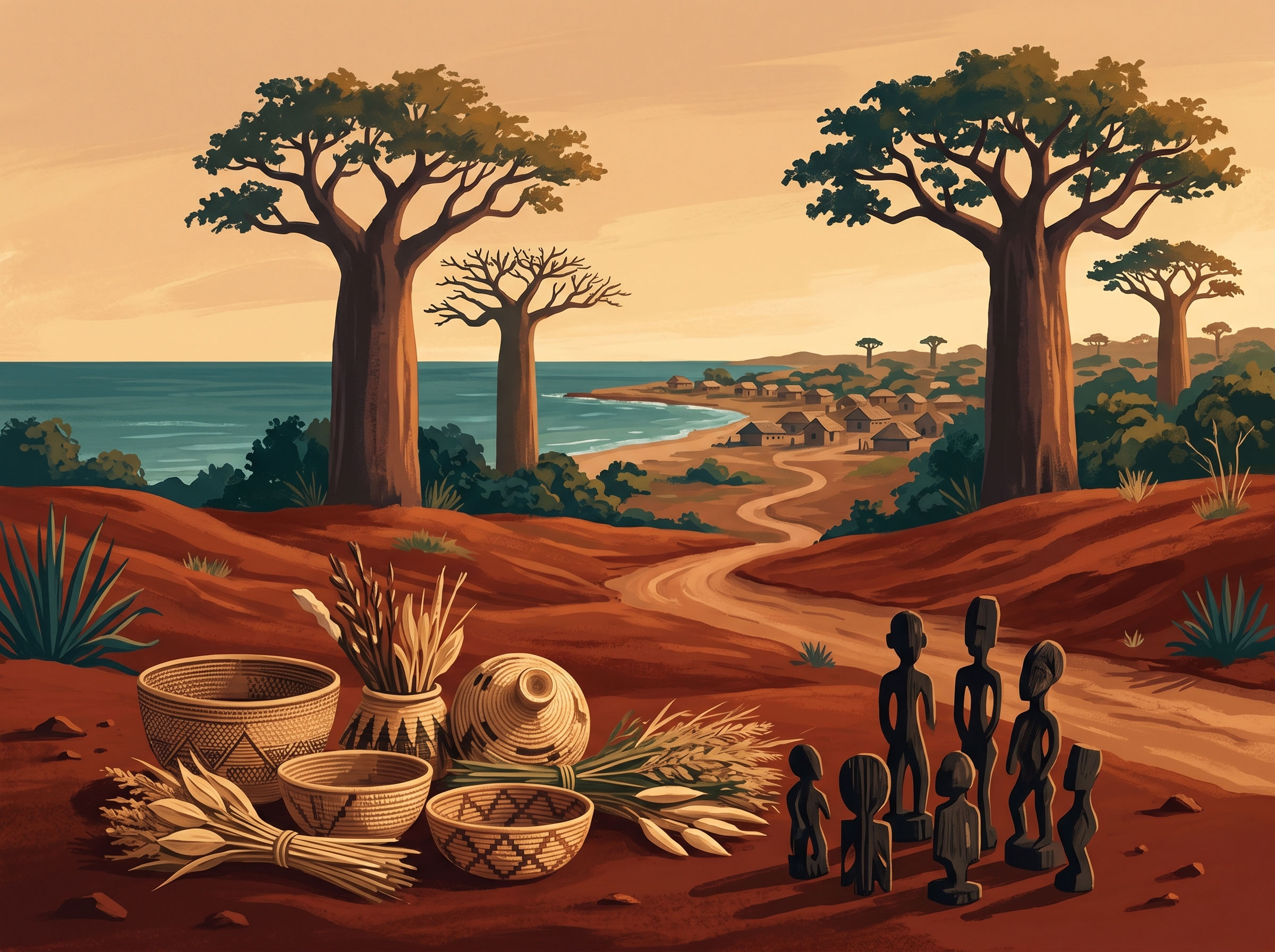
The Makonde are best known internationally for their extraordinary tradition of figurative wood carving, but their female initiation practices are equally sophisticated. The Makonde unyago — a female initiation ceremony — includes instruction in labia lengthening alongside a broader curriculum of body knowledge, song, and ceremonial practice. Makonde unyago specialists — senior women who hold expertise in the ceremony’s content — are referred to as nankungwi, and their knowledge is treated as a form of cultural specialization deserving respect and compensation.
In central Mozambique, among the Sena and Ndau communities of the Zambezi valley, similar practices have been documented, often connected to broader female initiation rites. The Swahili-influenced communities of the coast present a somewhat different context: here, the practice exists alongside Islamic traditions that in some cases actively discourage female genital modification but in others have historically accommodated or even encouraged labia stretching as distinct from the more severe practices that Islamic law addresses.
Mozambique’s colonial history — it was a Portuguese colony until 1975 — created specific disruptions in traditional practice. The Catholic Church, which had deep institutional presence throughout the colonial period, worked to suppress initiation ceremonies. In the post-independence period under Frelimo’s socialist government, traditional practices were sometimes discouraged as obstacles to modernization. The result has been uneven survival of the tradition across different communities and regions.
Symbolism, Meaning, and the Body as Cultural Text
Across all of the communities examined here, certain consistent symbolic themes emerge from the historical and ethnographic record. They are worth examining closely, because they reveal something important about how different cultures construct ideas of femininity, sexuality, and bodily value.
The first is the idea of the body as a site of active cultivation. In all of these traditions, the female body is not something that simply exists in a fixed state but something that is worked on, attended to, and shaped over time. Labia stretching is, in this sense, analogous to other forms of bodily cultivation — physical training, tattooing, scarification, or the application of decorative pigments — in that it represents the investment of time and intention in the body. A woman who had not stretched her labia in these communities was sometimes perceived as someone who had not attended to herself, not someone who had preserved a “natural” state.
The second theme is the relationship between elongated labia and sexual pleasure. Across communities from Uganda to Mozambique, the tradition is consistently described as being partly about enhancing the experience of sexual intercourse for both partners. Many women in these communities report that longer labia are associated with increased sensation during intercourse, and the cultural expectation that a woman should be an active and pleasurable partner is built into the tradition’s rationale. This is historically unusual in global terms: many body modification traditions across cultures are oriented toward male pleasure at female expense. Here, the female body’s capacity for pleasure is explicitly part of the tradition’s stated purpose.
The third theme is intergenerational connection. The fact that the practice is transmitted from older women to younger ones — typically in private, domestic settings, through trusted relationships — means that it functions as a form of cultural and bodily inheritance. Many women from these traditions describe the experience of being taught by an older relative as a formative one, not only in terms of the physical practice but in terms of the sense of connection to a lineage of women who had come before.
For a deeper account of the ancient tradition of labia stretching and how it has been documented across different eras and cultures, the full historical survey offers a broader chronological perspective.
📌 Cultural Callout
Three Consistent Cultural Functions
Despite regional variation, researchers consistently document three core functions of labia stretching across sub-Saharan communities:
- Initiatory — marking the passage from girlhood to womanhood within a recognized social framework
- Relational — connecting a woman to older female relatives and to the ancestral knowledge they carry
- Pleasurable — explicitly oriented toward enhancing female and partner sensation, a culturally sanctioned goal
The Diaspora: Tradition in Transit
Migration changes traditions. It does not always kill them — sometimes it preserves them with unexpected intensity, because displaced communities cling to cultural practices as a form of identity maintenance. But it always changes the conditions under which practices are transmitted, understood, and debated.
For women from Uganda, Rwanda, Zambia, Malawi, and Mozambique who have settled in the United Kingdom, Canada, the United States, Australia, and European cities, labia stretching has followed a variety of trajectories. Some diaspora women continue the practice and, if they have daughters, face the decision of whether and how to transmit it. Others have let it go, either because the older women who would have taught them are no longer present or because the urban, Western environments in which they live feel inhospitable to a practice so firmly rooted in private, communal female knowledge.
A third group — perhaps the most culturally interesting — has rediscovered or reclaimed the practice as adults. Research into diaspora communities in the UK, where significant Ugandan, Zimbabwean, and Zambian populations exist, suggests that some women who were not taught the tradition in childhood have sought out information about it as adults, motivated by a desire to reconnect with ancestral heritage. Online communities have played a significant role in this, providing information, community, and a degree of anonymity that allows discussion of a practice that remains difficult to talk about openly in most social settings.
The diaspora context has also produced a new audience: women of non-African backgrounds who have encountered labia stretching through cultural interest, personal curiosity, or relationships with partners from communities where the practice originates. This is a genuinely new development — the practice moving beyond its ethnic and geographic origins into a space of global body curiosity — and it raises interesting questions about cultural transmission, appropriation, and the universality of bodily experience.
“Migration changes traditions. It does not always kill them — sometimes it preserves them with unexpected intensity, because displaced communities cling to cultural practices as a form of identity maintenance.”
— James Whitmore, Cultural Historian
Regional Snapshot: Key Variations at a Glance
Modern Perspectives: Continuity, Conflict, and Choice
The question of how labia stretching fits into the modern world is genuinely complex, and any honest account of the tradition must acknowledge the tensions that surround it.
On one side of the debate sit researchers, public health officials, and some women’s organizations who have raised concerns about the practice when it is performed on young girls without their meaningful consent. The concern here is not with the practice itself — adult women across all of these countries continue to practice it voluntarily — but with the conditions under which it is transmitted. When girls are introduced to the practice at ages eight or nine, before they can understand the social meanings being attached to their bodies, questions of consent and autonomy naturally arise.
On the other side sit cultural practitioners, traditional authorities, and many women from these communities who argue that the practice represents an important form of ancestral knowledge that outsiders — particularly Western researchers and international health organizations — are poorly positioned to evaluate. This argument has particular force when it comes from African feminist scholars rather than from Western critics, because it cannot be easily dismissed as cultural defensiveness from people who have not considered the issues carefully.
Research suggests that among adult women in these communities, the practice is broadly viewed positively. Studies conducted in Uganda and Rwanda in particular find that women who have stretched their labia report high levels of satisfaction with the practice, typically framing it as connected to their sense of cultural identity, their relationships with older female relatives, and — for many — their sexual self-knowledge. Many women report that they intend to teach the practice to younger female relatives, suggesting that it is not primarily experienced as a form of coercion but as a valued inheritance.
The contemporary picture is also shaped by the emergence of labia stretching as a global phenomenon. Increasingly, women of non-African backgrounds are encountering information about the practice online, exploring it out of personal curiosity, and — in some cases — adopting it. This is a different conversation from the one about cultural transmission within traditional communities, and it raises its own distinct questions about how ancient body practices travel across cultural contexts and acquire new meanings in the process.
Myths, Misconceptions, and What the Record Actually Shows
Any practice this poorly understood in mainstream discourse inevitably accumulates a body of myths. Several are worth addressing directly.
Myth: The practice is dying out. Evidence does not support this. While urban migration and changing social conditions have reduced the consistency of transmission in some communities, multiple research projects confirm that the practice remains widely known and practiced in rural areas across Uganda, Rwanda, Zambia, Malawi, and Mozambique. Its emergence in diaspora communities and its growing presence in online body modification communities suggests that it is, in some ways, expanding its geographic reach even as its traditional social infrastructure changes.
Myth: Men impose the practice on women. Historical record consistently shows that labia stretching is taught by women to women, in private, female-only spaces. Men are typically excluded from the instruction process. Some communities include male preferences in the tradition’s cultural rationale — elongated labia are considered desirable by men in these traditions — but this is different from men directing or controlling the practice. Its transmission is a female-led, female-managed domain.
Myth: It has no effect on sensation. This is difficult to study rigorously and the evidence is limited. However, many women within these traditions report that the elongated labia do contribute to sensation during intercourse, both for themselves and their partners. The tradition’s stated rationale around pleasure is not merely a cultural fiction — it corresponds to what many women in these communities report from personal experience.
Questions & Answers
What These Traditions Tell Us
Labia stretching across Africa is not one tradition but many — a family of related practices that share common elements but differ in the social frameworks, cultural meanings, and transmission methods that surround them. What unites them is a shared orientation: the body as something to be attended to, a woman’s anatomy as worth knowing and cultivating, and the knowledge of older women as something worth transmitting.
What makes this tradition particularly interesting to the cultural historian is precisely its resistance to easy categorization. It is not quite like scarification, which primarily serves a social marking function. It is not quite like piercing, which is primarily aesthetic. It sits in a category of its own: a private, female-transmitted practice with aesthetic, social, sensory, and initiatory dimensions simultaneously.
Its survival across centuries of colonial disruption, religious suppression, urban migration, and changing social norms speaks to something about the particular kind of knowledge it represents. It is knowledge that lives in the body and in the relationship between women — not in books, not in institutions, not in formal curricula. That has made it difficult for outsiders to document, understand, or suppress completely.
For researchers, the tradition continues to offer insight into how cultures construct femininity, how body knowledge travels across generations, and how the private sphere functions as a repository of cultural practice when the public sphere is hostile or indifferent. For women from these communities — wherever in the world they now live — it continues to raise the enduring question of which parts of an ancestral inheritance are worth carrying forward, and how.
These are not simple questions. They rarely are, when bodies and cultures and generations are involved.
📋 In Brief
What This Article Covers
- Labia stretching has been practiced across sub-Saharan Africa for centuries, with written records from the 15th century onwards
- The practice carries distinct names and social frameworks in Uganda, Rwanda, Burundi, Zambia, Malawi, and Mozambique
- Transmission is consistently female-led — taught by aunts, grandmothers, or specialist women within initiation ceremonies
- The WHO classifies labia stretching as distinct from FGM — it involves no cutting or tissue removal
- Studies in Uganda and Rwanda find that adult women broadly view the practice positively
- Diaspora communities and global body curiosity have created new pathways for the tradition beyond its geographic origins


