
Somewhere in the highland villages of Rwanda and Uganda, and across the lake shores of Tanzania, an old practice endures — one that most of the outside world has never heard of, yet which has shaped the lives of women across generations. It has no single inventor and no founding date. It grew the way oral traditions do: passed from aunt to niece, mother to daughter, elder to girl, in quiet moments before the wider world could interrupt.
This is the history of labia stretching in East Africa — one of the oldest forms of deliberate female body modification recorded on the continent, and one of the least understood.
A Tradition Without a Single Origin
Historians and anthropologists who have studied body modification across sub-Saharan Africa consistently note that labia elongation — the deliberate stretching of the labia minora — does not belong to any single ethnic group. Research suggests it spread across a broad corridor of East and Central Africa long before colonial-era borders existed. It is documented among the Hima and Tutsi of Rwanda and Uganda, the Nyakyusa of Tanzania, the Luo of Kenya and South Sudan, and numerous smaller groups whose names rarely appear in Western academic literature.
The precise age of the practice is impossible to pinpoint. Unlike architecture or pottery, body modifications leave no physical trace in the archaeological record. What researchers work with instead are oral histories, ethnographic accounts from the 19th and early 20th centuries, and comparative cultural analysis. Taken together, these sources strongly suggest the practice is centuries old — and may predate the Bantu migrations that reshaped much of East Africa roughly 2,000 years ago.
In Rwanda, the practice is known as gukuna imishino — loosely translated as “pulling the labia.” Historically, it was not a secret ritual but a rite of preparation. Girls between the ages of roughly eight and fifteen were taught by female relatives before marriage. The goal was not pain or endurance, but gradual change over time.
Rwandan cultural understanding held that elongated labia contributed to a woman’s desirability and her ability to give and receive sexual pleasure — values that were openly discussed within the family, without shame.
What makes East Africa particularly significant in the study of this tradition is the sheer geographic reach and cultural consistency. From the shores of Lake Victoria to the plateaus of the East African Rift, women across dozens of distinct language groups developed nearly identical practices — using the fingers or small tools, applying plant oils, and stretching tissue slowly across months or years. The similarity of method across unconnected communities is striking to researchers and suggests either a very ancient shared origin or, more likely, independent development driven by shared cultural values around femininity and the body.
Rwanda: Where the Practice Is Best Documented
Of all the East African nations where labia elongation has been studied, Rwanda offers the richest body of documentation. The practice of gukuna imishino was so embedded in Rwandan social life that it attracted consistent ethnographic attention through the 20th century. Studies from the 1960s onward record the practice across both Hutu and Tutsi communities, suggesting it crossed ethnic lines in ways that many other cultural rituals did not.
Research published by ethnographers working in Rwanda in the 1980s and 1990s found that a significant majority of adult women in rural areas had participated in some form of labia stretching in childhood or adolescence. Many women reported that aunts — rather than mothers — were typically responsible for teaching the practice, a pattern that reflected broader East African models of intergenerational female knowledge transfer, where intimate bodily knowledge was considered appropriate to pass through female kinship networks rather than directly from parent to child.
“
The similarity of method across unconnected communities — across language, across distance, across centuries — is striking. It suggests something deeper than custom: a shared understanding of the female body as a site of beauty, identity, and cultural continuity.
“— James Whitmore, Cultural Historian
The social significance attached to elongated labia in Rwanda went beyond aesthetics. Historically, a woman who had practiced gukuna imishino was considered more sexually knowledgeable and more prepared for marriage. Oral histories collected by researchers suggest that elongated labia were associated with heightened sexual pleasure for both women and their husbands — and that this association was part of the tradition’s social logic, not a secondary consideration.
Uganda and the Great Lakes Region
In Uganda, labia elongation has been documented across multiple ethnic groups in the southwestern highlands, particularly among communities in the Ankole and Kigezi regions. Like its Rwandan counterpart, the Ugandan tradition was historically organized around female kinship. Studies exploring body modification in the Great Lakes region note that young girls would begin the practice under the guidance of an older female relative — often after their first menstrual period, though some accounts suggest it could begin earlier.
In several Ugandan communities, the practice carried a name that roughly translates as “the work of women” — a phrase that speaks to how thoroughly embedded the tradition was in female social life. It was not framed as something done to women by culture, but as something women did among themselves, for reasons they controlled and understood.

Regional Context — Origins & Culture / East Africa
Historical accounts from early European missionaries and colonial administrators — however biased their framing — consistently noted the practice’s prevalence and the confidence with which women spoke about it. Several 19th-century accounts from the region describe adult women actively teaching girls, with no sense that the tradition required secrecy or defense. Its normalcy within these communities is itself historically significant.
Tanzania: The Southern Reach
In Tanzania, labia stretching has been recorded most consistently among the Nyakyusa people of the southwestern highlands and among several smaller groups along the shores of Lake Tanganyika and Lake Victoria. Among the Nyakyusa, anthropologist Monica Wilson’s landmark studies of the mid-20th century documented the practice as part of a broader female initiation framework that also included instruction in sexual behavior, marriage customs, and the management of intimate relationships.
Wilson’s fieldwork, conducted in the 1930s and 1940s, remains one of the most detailed ethnographic records of labia elongation in Tanzania. Her accounts describe a tradition that was neither covert nor compulsory in the modern sense of the word — women within the communities she studied reported the practice as part of growing up, something expected and understood rather than forced. The framing in these accounts is consistently one of women’s agency within a structured cultural system.
The Role of Plant Medicines and Traditional Methods
Across East Africa, the physical method of labia stretching followed remarkably consistent patterns. The labia minora were typically worked with the fingers — pulling and rolling the tissue — often after applying a plant-based oil or fat to reduce friction and soften the skin. Different communities favored different plants: certain bark oils, shea butter, castor oil, and various local plant extracts appear in ethnographic accounts across Rwanda, Uganda, and Tanzania.
The selection of oils was not incidental. In many communities, knowledge of which plants to use was itself part of the transmitted wisdom — another layer of botanical knowledge held by older women and passed down through kinship networks. Research into traditional African plant medicine suggests that several of the plants historically used in this context have genuine emollient and anti-inflammatory properties, though the women who used them would not have described their effects in those terms. They knew what worked.
Colonial Disruption and the Silence That Followed
The 20th century brought significant outside pressure to bear on traditional African body practices. Colonial administrations across East Africa generally viewed indigenous customs related to sexuality and the body with a mixture of suspicion and disapproval. Missionary activity reinforced this, introducing new frameworks of bodily modesty that treated labia elongation as aberrant rather than cultural.
The result was not the elimination of the practice — it was its retreat from public visibility. Communities that had practiced labia stretching openly began to do so more quietly. The tradition moved further into the realm of female-only knowledge, shared in domestic spaces rather than discussed across broader community life. In many places, this pattern of concealment became the new normal: the practice continued, but its cultural scaffolding — the songs, the formal teaching moments, the public acknowledgment — began to erode.
Post-independence governments in Rwanda, Uganda, and Tanzania took varying approaches to traditional body practices. Some framed them as cultural heritage worth preserving; others, influenced by international health frameworks, categorized labia elongation alongside harmful practices — a classification that many researchers and cultural advocates have since challenged as scientifically unsupported and culturally reductive.
The classification problem: In 2010, the World Health Organization’s categorization framework prompted significant debate about whether labia elongation belonged alongside practices involving tissue removal or damage. Researchers including Ines Kappeler and others who conducted fieldwork in Rwanda argued strongly that it did not — and that applying the same category to a non-injurious practice was both scientifically inaccurate and culturally dismissive.
Studies conducted in Rwanda in the 2000s and 2010s found that the overwhelming majority of women who had practiced gukuna imishino reported no negative physical effects and described the practice in neutral to positive terms.
Survival and Contemporary Presence
Despite a century of external pressure, labia elongation has not disappeared from East Africa. Research conducted in Rwanda between 2010 and 2020 found the practice still widely present in rural communities, with many women reporting that they had learned it from older female relatives and that they intended to pass the knowledge on. Urbanization has altered the picture somewhat — studies suggest the practice is less common among women who grew up in cities than among those from rural backgrounds — but it has not vanished from urban life entirely.
In Uganda, a 2019 qualitative study published in the journal Culture, Health & Sexuality found that many women in Kampala who had migrated from rural southwestern Uganda maintained the practice privately. Interestingly, several women in that study reported that their husbands — including husbands who had grown up in urban settings — were positively familiar with and appreciative of the tradition, suggesting that cultural knowledge travels with communities even when the formal teaching structures break down.
For a broader understanding of how this tradition developed across the African continent and how it compares to related practices in Southern and West Africa, the site’s overview of the ancient tradition of labia stretching provides useful historical context and comparative depth.
The Intergenerational Question
One of the most consistent threads running through the anthropological literature on East African labia elongation is the question of intergenerational transmission. How does a practice survive without formal institutions to carry it? The answer, in this case, appears to be kinship — specifically, the bonds between women across age groups within extended family networks.
Many women interviewed in ethnographic studies describe learning the practice not as a formal lesson but as a quiet, intimate moment with an older female relative — an aunt, a grandmother, an older sister. The teaching was embedded in ordinary time spent together, not marked off as a ritual or ceremony. This informality may be part of why the practice has proven durable: it does not depend on formal institutions that can be abolished or disrupted. It depends on women talking to each other.
This model of transmission is itself a form of cultural architecture — distributed, resilient, and deeply human. Historically, societies that relied on oral and intimate transmission of knowledge often proved more adaptable than those dependent on centralized institutions. The survival of labia elongation across colonial disruption, post-independence policy shifts, and rapid urbanization is, in part, a product of that resilience.
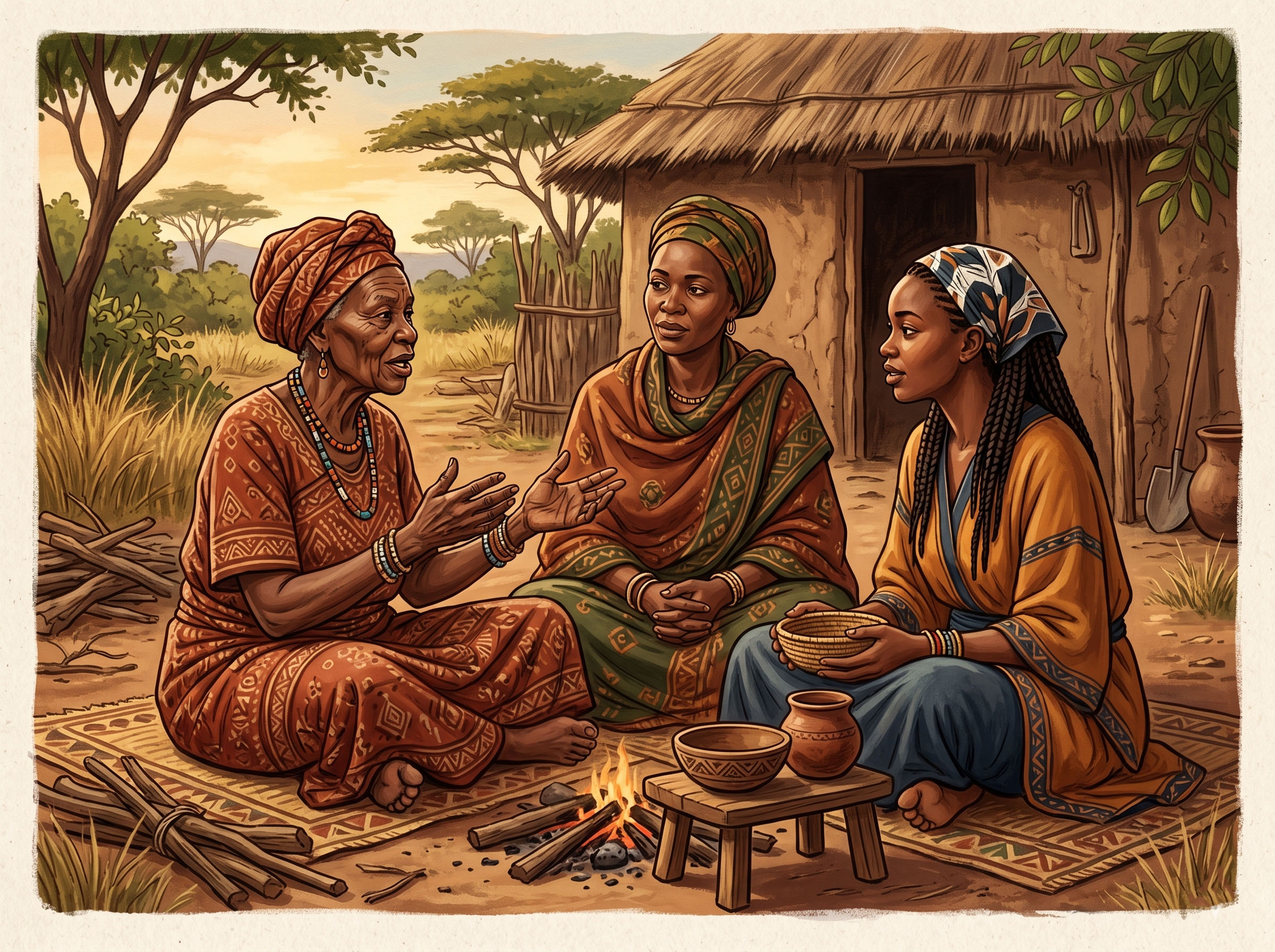
Intergenerational Transmission — Traditions & Practices / Origins & Culture
What Men Have Historically Understood
It would be historically inaccurate to treat East African labia elongation as a practice that existed outside of male awareness. In the communities where it has been most documented, men were generally aware of the tradition — and, according to the ethnographic record, generally held positive views of it. Studies conducted in Rwanda, Uganda, and Tanzania across several decades consistently found that men from communities where the practice was common associated elongated labia with sexual experience, desirability, and marital attractiveness.
This male awareness was not passive. Oral histories from Rwanda in particular suggest that the knowledge that a woman had practiced gukuna imishino carried social meaning within marriage — it signaled preparation, maturity, and care for the relationship. Some accounts suggest that women’s relatives actively considered a prospective husband’s likely familiarity with the tradition when evaluating marriage prospects.
The picture that emerges from the historical record is not one of a practice imposed on women for the benefit of men, nor one entirely separable from male values and expectations. It is more accurate — and more interesting — to describe it as a practice that existed within a web of mutual cultural understanding, where women’s bodies, women’s knowledge, and male appreciation were entangled in ways specific to each community’s values.
Women who are curious about how these traditions are understood and preserved today, including the perspectives of both African women and contemporary practitioners worldwide, will find substantial depth in the site’s section on preserving the tradition — a thoughtful look at how ancient practices adapt without disappearing.
A Living History
The history of labia stretching in East Africa is not a closed chapter. It is a living practice with documented roots stretching back further than most written records reach, carried forward through kinship and quiet conversation across some of the most turbulent centuries in African history. It survived the imposition of colonial moral frameworks. It survived the disruption of urbanization. It is being studied, debated, and in many communities, still practiced.
For historians and anthropologists, it presents a case study in how body-based cultural knowledge is transmitted, contested, and preserved. For the women who have practiced it across generations — and for the women who practice it today — it is something more immediate than history. It is a connection to the women who came before them, passed hand to hand across time.
Research in this field is still growing. Ethnographic work continues in Rwanda, Uganda, and Tanzania, and a new generation of African scholars is beginning to reclaim the study of these traditions from the largely Western academic frameworks that have dominated the literature. What that new scholarship will find — and how it will change the understanding of a practice this old — is one of the more compelling open questions in the anthropology of the body.
Frequently Asked Questions
- Labia stretching has been documented across dozens of East African ethnic groups spanning Rwanda, Uganda, Tanzania, Kenya, and Burundi.
- The Rwandan practice of gukuna imishino is the best-documented tradition on the continent.
- Teaching was historically transmitted through female kinship networks — most often from aunt to niece.
- Plant-based oils and manual stretching were the consistent method across communities.
- Colonial and missionary influence pushed the practice from public life into domestic spaces, but did not eliminate it.
- Research from 2010–2020 confirms the tradition remains active in both rural and urban East African communities.
- Men in these communities were historically aware of and positive toward the practice.


Leave a Reply